HYROX Sled Push: Technique, Standards, Training, and Race Strategy
The HYROX Sled Push is where a lot of strong runners meet their first “full-stop” moment. It’s short on paper (50m), but it spikes your heart rate, lights up your quads, and can make the next 1k run feel brutal if you overcook it. The good news: the sled push is one of the most trainable stations—small technique tweaks and smart pacing can save big chunks of time.
Below you’ll find the race standards, the highest-ROI technique cues, pacing strategy, and the best workouts to improve your sled push (plus scaling options if you don’t have a sled).
Where the Sled Push falls in the race (and why it matters)
- Race order: Run 1 (1km) → Station 1: SkiErg (1000m) → Run 2 (1km) → Station 2: Sled Push (50m) → Run 3 (1km) → Station 3: Sled Pull…
- Why it matters: This is the first truly heavy leg-dominant station, and it comes early—when it’s tempting to go too hard. If you redline here, you don’t just lose time on the sled; you also pay for it on the next run and the sled pull. The goal is a fast, repeatable effort across all 4 lanes, not a max-effort grind that forces stalls.
Sled Push at a glance (quick wins)
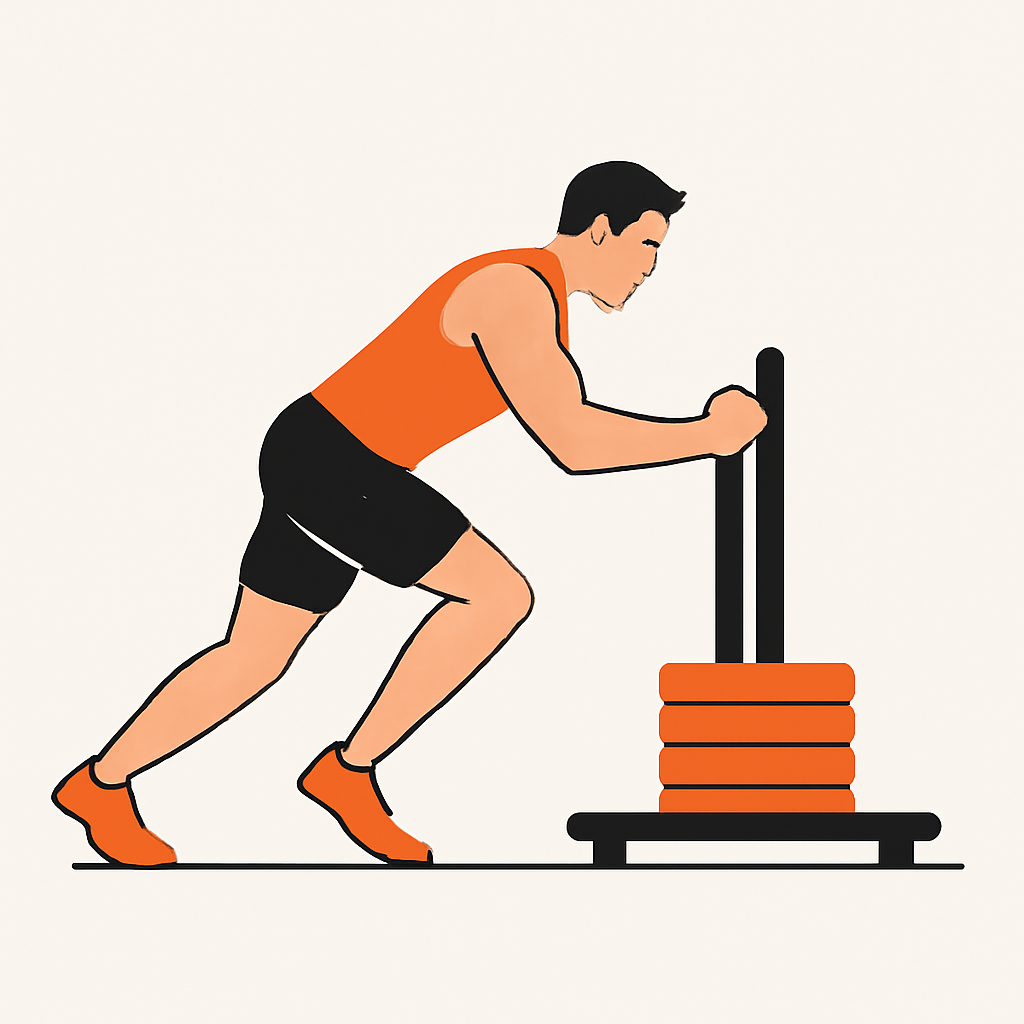
- Stay low and drive forward: think “push through the sled,” not “push down on the sled.”
- Short, fast steps win: choppy steps keep traction and stop the sled stalling.
- Arms locked, ribs down: a solid brace prevents energy leaking through your torso.
- Don’t sprint lane 1: aim for a hard but repeatable effort across all 4 lanes.
- Win the transition: 3–5 seconds saved at the start and turnarounds is “free time.”
What is the HYROX Sled Push?
In HYROX you push a loaded sled for 50 meters total, completed as 4 × 12.5m lanes (down-and-back style). Done well, it’s about traction, body angle, and pacing—not just strength.
Why it matters
- It’s a high-force, high-fatigue station that can wreck your run if you spike too hard.
- Performance is heavily influenced by traction + body position, not just leg strength.
Official standards and rules (what counts)
Distance and completion
- Distance: 50 meters (4 × 12.5m)
- You must finish all 4 lanes (missing lanes can result in penalties).
- The sled must fully pass the end-of-lane mark before you change direction.
Lane discipline
- You’ll be assigned a lane and must stay in your lane and not interfere with others.
- Both sled and racer must be behind the line before starting.
Division weights (Singles)
All weights are including the sled:
- Women Open: 102kg
- Men / Mixed Open: 152kg
- Women Pro: 152kg
- Men Pro: 202kg
sleds, flooring, and “feel” can vary by venue—train the pattern and pacing, not just the number.
HYROX Sled Push technique (step-by-step)
1) Setup (win the first 2 meters)
- Hands: medium height on the poles so shoulders stay stacked and stable.
- Body angle: lean forward so shoulders are slightly ahead of hands.
- Feet: start with a strong first step, not a long reach.
Cue: Chest over the work. Short steps.
2) Drive phase (keep it moving)
- Step length: keep steps short and fast—long steps often cause slipping.
- Force direction: push forward; if hips rise and you push down, you’ll lose traction.
- Brace: ribs down, glutes tight, quiet spine.
Cue: Run the sled—don’t deadlift it.
3) Turnarounds (free seconds)
- As the sled crosses the line, release one hand, pivot fast, re-grip, and go.
- Don’t stand up fully—stay low so you restart quickly.
Cue: Turn low, go now.
4) Breathing (don’t redline)
- Use sharp exhales every 2–3 steps.
- If you hold your breath, your legs flood faster and the next run suffers.
Common mistakes (and fast fixes)
Mistake 1: Hips too high (turns into a slippery grind)
Fix: lower your chest and bend knees more; keep pressure forward.
Mistake 2: Overstriding
Fix: shorten steps and increase cadence—traction improves immediately.
Mistake 3: “All-out” lane 1
Fix: pick a pace you can repeat for 4 lanes; slight negative split if you can.
Pacing and race strategy
The goal
A sled push that feels hard but controlled, so you can run well immediately after.
Practical pacing plan
- Lane 1: controlled aggression (RPE ~8/10)
- Lane 2: match lane 1 (avoid the first stall)
- Lane 3: commit—this is where people quit mentally
- Lane 4: push harder if traction is good; otherwise keep it smooth and finish clean.
If you stall
- Don’t panic and sprint in place.
- Reset your body angle (lower), shorten steps, and restart with 3–5 powerful choppy steps.
Transition to the run
- Take 10–20 seconds to get your breathing under control, then settle into your planned 1k pace.
- Expect the first 200–300m to feel heavy—focus on cadence and posture, not speed.
Training the sled push: what actually improves it
Think in three buckets:
1) Skill + traction (1–2x/week)
You’re training:
- body angle
- foot speed
- turn efficiency
- repeatability under fatigue
2) Strength (1–2x/week)
You’re building:
- quad + glute drive
- trunk stiffness (brace)
- calf/ankle robustness for traction
3) Conditioning under load (1x/week)
You’re training:
- recovering quickly after high-force work
- compromised running (running well when legs are full)
Best workouts to improve your HYROX sled push
Beginner (technique + repeatability)
A) Smooth Lanes
- 6 rounds: 12.5m sled push @ moderate load
- Rest 60–90s
Focus: zero stalls, fast turns.
B) Short-Step Builder
- 4 × 25m sled push
- Rest 2–3 min
Focus: short steps, consistent torso angle.
Intermediate (race-specific power)
C) HYROX Split
- 2 rounds:
- 500m run @ controlled hard
- 25m sled push @ race load
- 2 min easy walk/jog
Focus: run well after pushing.
D) Lane Ladder
- 12.5m / 25m / 37.5m / 50m
- Rest 2–4 min between efforts
Focus: holding form as fatigue rises.
Advanced (under-fatigue + pacing discipline)
E) “Don’t Stall” Intervals
- 5 rounds:
- 12.5m sled push @ slightly heavier than race
- 200m run fast but relaxed
- Rest 90s
Focus: restart speed + controlled breathing.
F) Mini Simulation
- 1k run
- 500m SkiErg
- 50m sled push
- 1k run
Focus: station-to-run execution.
Strength and accessory work that carries over
Rotate 2–4 of these weekly:
- Heavy sled push or prowler (short distances, full recovery)
- Front squat / high-bar squat (quad-dominant strength)
- Split squats (especially long eccentrics)
- Hip extension (RDLs, hip thrusts) for drive + posture
- Core bracing (dead bugs, loaded carries, Pallof presses)
- Calf/ankle work (raises + tibialis) for traction durability
No sled? Scaling options that still work
If you can’t access a sled, match the stimulus (forward drive + high quad load + traction challenge):
- Treadmill “push” (hands on rails, power walk at steep incline)
- Prowler substitute (if available, it’s closest)
- Heavy farmer carry into walking lunges (legs + breathing spike)
- Hill repeats (short, steep; focus on cadence)
- Wall sit + shuttle runs (quad fatigue + transition)
FAQs
How far is the HYROX sled push?
50 meters total, completed as 4 × 12.5m lanes.
What are the HYROX sled push weights?
Singles weights (including sled):
- Women Open: 102kg
- Men / Mixed Open: 152kg
- Women Pro: 152kg
- Men Pro: 202kg
What’s the most common reason people lose time on sled push?
Stalling from poor body angle + overstriding, especially after going too hard on lane 1.
Should I take breaks during the sled push?
If you must, take very short resets (1–3 breaths), then restart low with fast steps. Long breaks usually cost more than they save.
How often should I train sled push for HYROX?
Most athletes do best with 1 technique session + 1 strength/power exposure per week, then a race-specific compromised-running session every 1–2 weeks.
Coach’s 2-week micro-plan
Week 1
- Session 1: Smooth Lanes (6 × 12.5m) + squat accessories
- Session 2: HYROX Split (run + push) + easy aerobic
Week 2
- Session 1: Lane Ladder + single-leg strength
- Session 2: Mini Simulation (short) + easy aerobic